

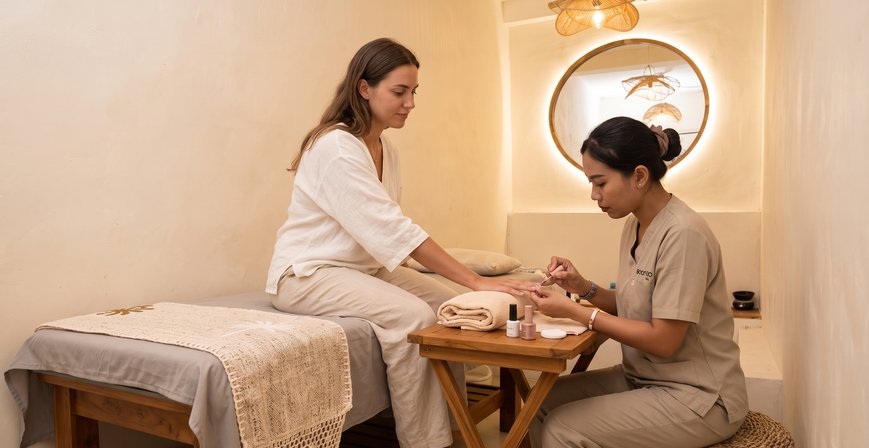
A gel manicure suits a Bali trip. It sets hard under the lamp before you leave the chair, and it stays glossy through two or three weeks of beach days and pool water. How healthy your own nails look afterwards is decided mostly at the end, when the gel comes off. In a 2020 survey of 2,118 women, about one in five reported a side effect while wearing gel polish. After removal, more than three in four did.
Who applies it, and who takes it off
That survey of side-effects associated with gel nail polish, run by dermatologists at Wroclaw Medical University and published in Acta Dermato-Venereologica, also split the women by who did their nails. Among those who had gel polish applied by a professional, 18% noticed changes in the nail plate after removal. Among those who applied it themselves, the figure was 56%. The changes were mostly softer nails, splitting, white spots and grooves.
Two things you might expect to matter did not. How many gel manicures a woman had in the past year made no difference to how often side effects appeared, and neither did how long she wore each set (most wore it for two or three weeks). What separated the groups was who did the work. Cured gel is a hard layer bonded to the surface of the nail, so picking or prying it off pulls at the nail underneath. The American Academy of Dermatology’s gel manicure tips ask people not to pick at a lifting edge and to book a removal instead.
What a gentle removal looks like
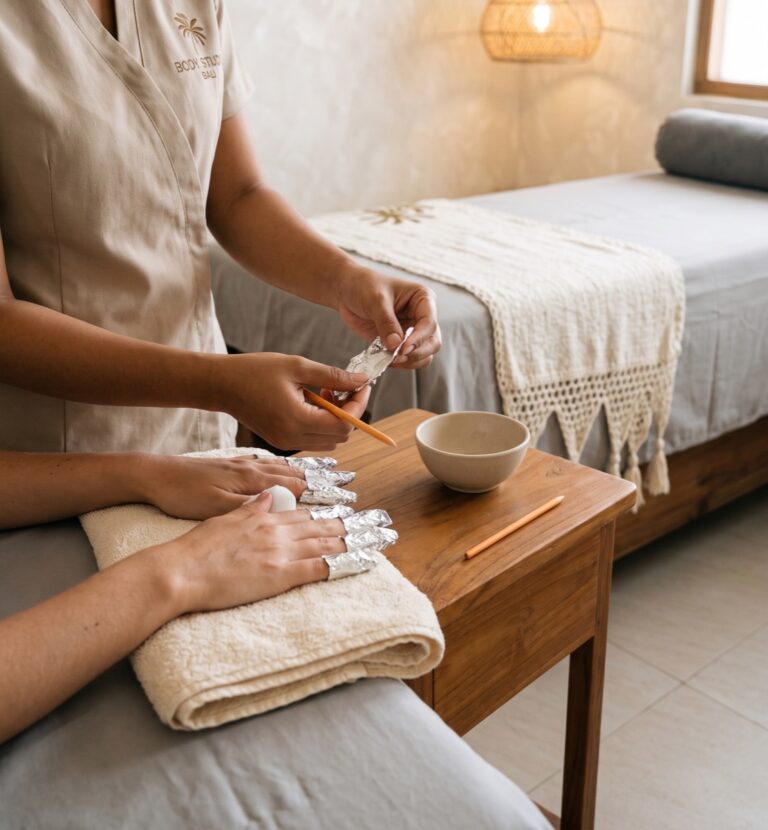
The same AAD page describes the method. Soak only the fingertips in acetone, not the whole hand. The other way is to put an acetone-soaked cotton pad on each nail and wrap the fingertip in a small square of aluminium foil. After about 15 minutes the gel should come right off. Only the nail touches the acetone, which protects the skin around it.
On a holiday, removal is a timing question. Most women in the survey wore each set for two or three weeks, so a set applied in the first days of a two- or three-week trip reaches the end of its wear close to the flight home. A lifting corner on a long flight is when most people start picking. Booking the removal at a salon in the last day or two of the trip avoids it.
The UV lamp and a layer of sunscreen
The lamp is the other step people ask about. Researchers at UC San Diego published a 2023 study of cells irradiated with a nail polish dryer in Nature Communications. They exposed human and mouse cells in a dish to a UV nail dryer for 20 minutes at a time. One session killed 20 to 30% of the cells, three consecutive sessions killed 65 to 70%, and the cells showed signs of DNA damage. It was a laboratory study on cells, not people, and the authors write that large epidemiological studies are needed to measure the actual risk to hands.
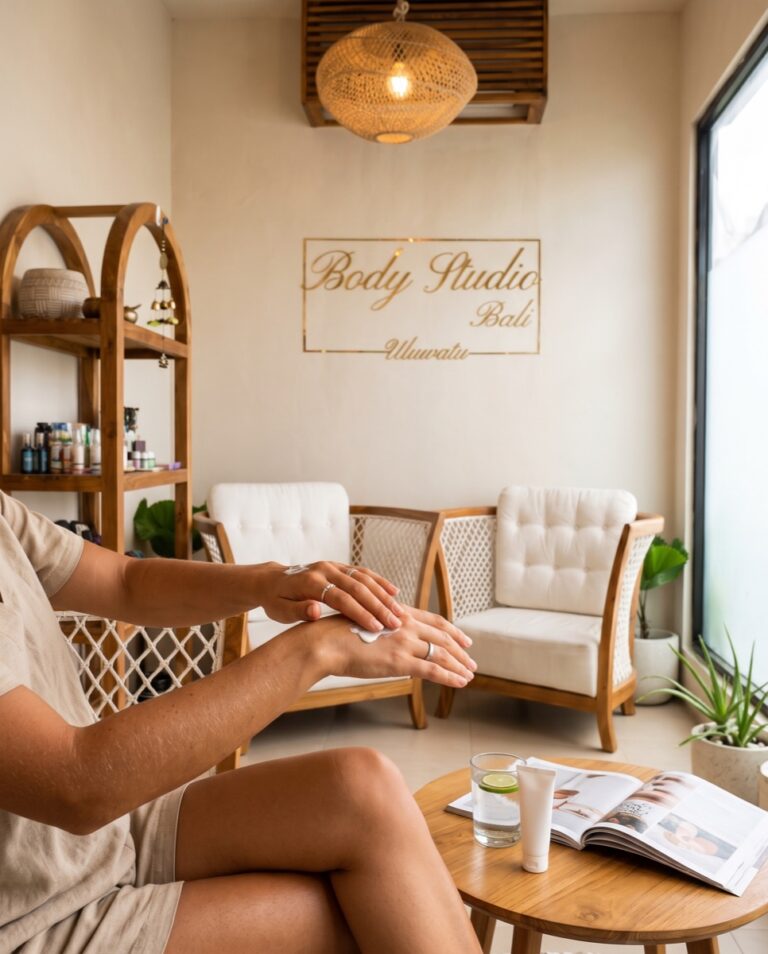
The AAD’s precaution is easy to follow in Bali, where sunscreen is already in your beach bag. Before the manicure, apply a broad-spectrum, water-resistant sunscreen of SPF 30 or higher to your hands. Dark, opaque gloves with the fingertips cut off, put on before the polish goes on, do the same job. If your hands have already had a week of strong sun, our piece on repairing Bali holiday skin after sun, salt and chlorine covers the skin around the nails.
Gel allergy, and why Europe made one ingredient salon-only
Gel polish is a mixture of acrylate monomers that a UV or LED lamp hardens into a solid layer. In people who become sensitised, those monomers cause allergic contact dermatitis: itchy, red skin on the fingertips or around the nail folds. A 2021 review of acrylates as a cause of allergic contact dermatitis in Advances in Dermatology and Allergology describes how this allergy, once seen mostly in dentists and dental technicians, has shifted to the beauty industry, with artificial nails as the main source.
An Italian patch-test study of the trend of contact allergy to 2-HEMA, published in Contact Dermatitis in 2025, found artificial nails behind 72% of the non-occupational cases of (meth)acrylate allergy, with dental prostheses second at 13%. The same monomers are used in dental materials and medical devices, so an acrylate allergy is worth knowing about beyond the nail salon. Since 2020 an EU regulation has restricted 2-HEMA, a common gel ingredient, in nail cosmetics to professional use, with packs labelled “For professional use only” and “Can cause an allergic reaction”. The Italian authors add that other acrylates which cross-react with 2-HEMA are still easy for the public to buy online. In trained hands, uncured gel stays off the skin and each coat is cured before the next one goes on.
Planning gel nails around your trip
The evidence points to a short routine. Have the set applied and taken off by a professional, since that alone separated 18% from 56% in the survey. Put sunscreen on your hands before the lamp, and book the removal rather than picking at an edge. Between sets, the AAD suggests a week or two without polish, with petroleum jelly rubbed into the nails and cuticles several times a day.
Manicure and pedicure are coming back to Body Studio Bali in Uluwatu, in the same studio as our body and face treatments. The manicure and pedicure page will carry the details and booking first.