


By 9 a.m. in Bali, a face that felt freshly washed at breakfast can already look shiny, feel slightly sticky and seem to hold every grain of dust from the road. That does not mean your skin has suddenly changed type. It is responding to heat, persistent humidity, sweat, sunscreen and, often, a completely different cleansing routine.
The phrase “Bali humidity skin” is often used as shorthand for clogged pores and breakouts, but humidity alone is not the whole story. High moisture in the air changes how efficiently sweat evaporates. Heat can increase oil output, while repeated layers of sunscreen, makeup and pollution add to what sits on the surface. The result can feel congested even when the underlying problem is irritation rather than genuinely “dirty” skin.
Your pores are not opening, but they may look more obvious
Pores do not open and close like tiny doors. Their visible size is influenced by anatomy, oil production, material collecting around the follicular opening and the way light reflects from the skin. In hot weather, increased sebum and sweat can make pores look more prominent, particularly across the forehead and nose.
A review of environmental influences on acne reports that sebum excretion rises with temperature, with an estimated increase of about 10% for every 1°C rise, and notes that acne is more common in hot or humid regions. The relationship is not simply “humidity causes acne,” but the association between heat, sebum production and acne helps explain why oily skin in Bali may behave differently from the same skin at home.
Humidity can also reduce the rate at which sweat evaporates. Sweat then lingers alongside sebum, sunscreen and environmental particles. Friction adds another variable: helmets, hat bands, tight activewear and damp swimsuit straps can trap heat and moisture against the skin. Small bumps in those areas are not necessarily acne. They may be irritation, follicular congestion or heat rash, and treating every bump with strong acne products can make matters worse.
The sunscreen-and-sweat problem is mostly about the film on your skin
Sunscreen remains essential in Bali. The practical difficulty is maintaining an even protective film when the face is sweating, being wiped with a towel or repeatedly touched. Sweat does not make sunscreen “toxic,” nor does it automatically mean the formula is clogging your pores. But sweating, rubbing and swimming can disturb coverage, which is why reapplication matters.
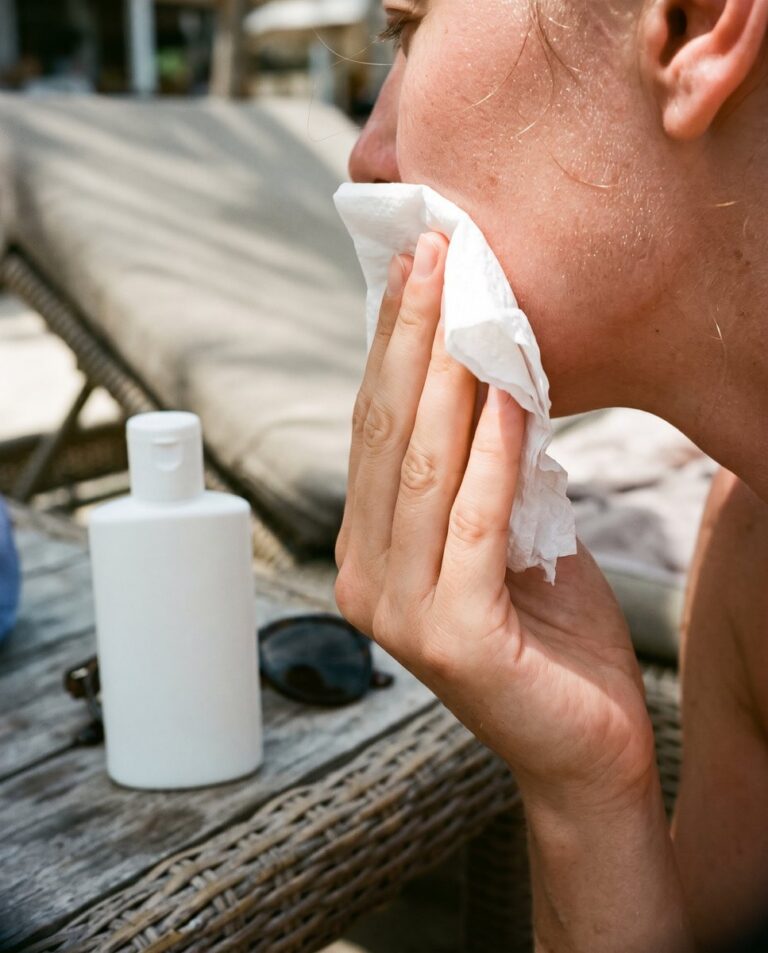
Applying more sunscreen over a wet, salty face can feel unpleasant and may produce pilling. If possible, blot rather than scrub, let the skin become reasonably dry, then reapply. Water-resistant sunscreen is useful for swimming and heavy sweating, but “water-resistant” does not mean waterproof or all-day. A lightweight texture may be easier to use consistently, although no single format suits everyone.
The same surface conditions can contribute to miliaria, or heat rash. According to the clinical explanation of miliaria, sweat ducts can become obstructed by skin debris and biofilm-forming bacteria. Trapped sweat leaks into surrounding skin, encouraging overhydration, swelling and further blockage. Miliaria rubra may affect up to 30% of adults living in hot, humid conditions. Prickly, closely grouped bumps that worsen with heat therefore deserve a different response from blackheads or deeper inflammatory acne.
Why aggressive cleansing often backfires
The instinct is understandable: if your face feels greasy by lunchtime, wash it again. Then use an exfoliating toner. Then scrub. Yet this approach can leave skin tight, stinging and still shiny. Cleansing removes sweat, oil, sunscreen and particles, but overly frequent or harsh cleansing also disrupts the surface lipids that help the barrier function normally.
Once irritated, skin may become less tolerant of products that were previously easy to use. Sunscreen stings. Retinoids suddenly feel too strong. Small red bumps appear around the nose or mouth. This is not proof that the skin is “purging,” and adding more acids is rarely the sensible first move.
For straightforward tropical skincare, a restrained routine is often easier to assess:
- Cleanse gently in the evening to remove sunscreen and the day’s buildup.
- After heavy sweating, rinse or use a mild cleanser rather than scrubbing.
- Keep moisturiser light if richer textures feel occlusive, but do not assume humid skin needs no moisturiser.
- Introduce exfoliants gradually instead of combining several active products at once.
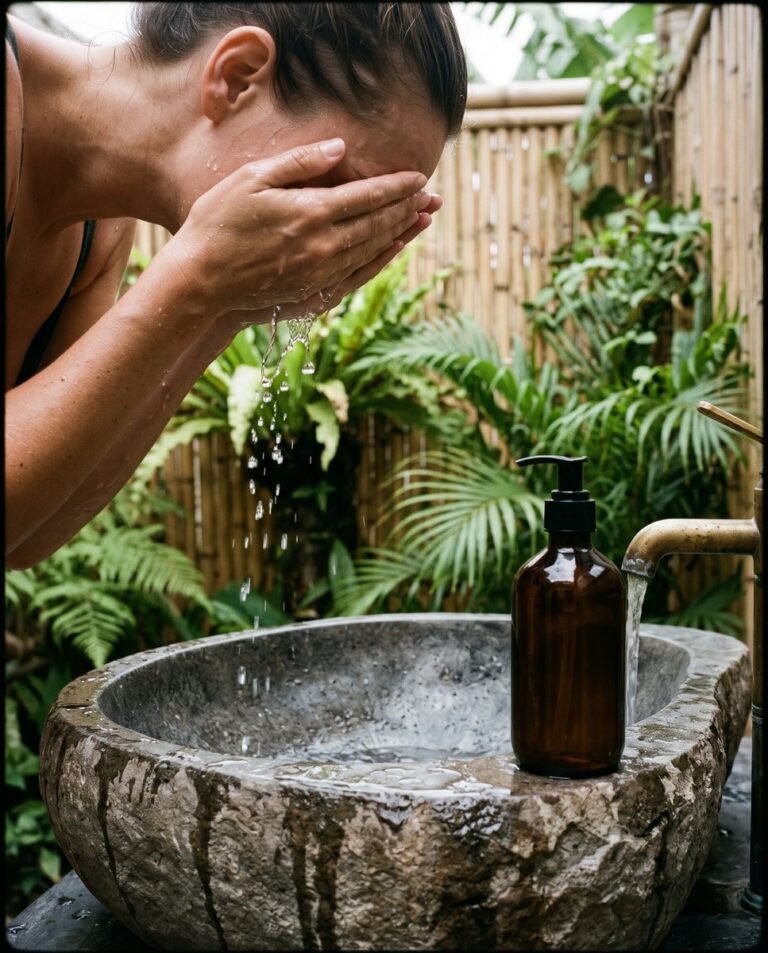
The goal is not to make skin feel squeaky. It is to remove the surface film without creating a second problem through barrier irritation. Body Studio Bali sees this distinction matter particularly for visitors who arrive with an elaborate routine designed for a cooler, drier climate.
The two-week adjustment is real as an experience, not a fixed biological deadline
Many visitors report that their skin settles after roughly one or two weeks. There is no universal two-week switch, however, and “skin adjustment tropics” is better understood as a period of changing habits and exposures. People learn how much moisturiser they need, find a sunscreen texture they will reapply, stop wearing heavy makeup in midday heat and become less likely to over-cleanse after every bead of sweat.
Some skin will not simply adjust. Persistent painful acne, spreading rash, intense itching, crusting, swelling or bumps accompanied by fever warrant medical assessment. Heat rash usually benefits from cooling and reducing occlusion, but the different depths and forms of miliaria can look and feel different. Likewise, acne linked with increased oil production may require a more specific plan than changing cleanser alone; the environmental literature supports an association with heat and humidity, not the idea that Bali is the sole cause of every breakout.
The most useful response is observation rather than panic. Notice where bumps form, what touches that area, whether they itch, and whether the skin feels oily, sore or tight after cleansing. In Bali’s climate, the simplest routine is often the one that makes those signals easiest to read.